
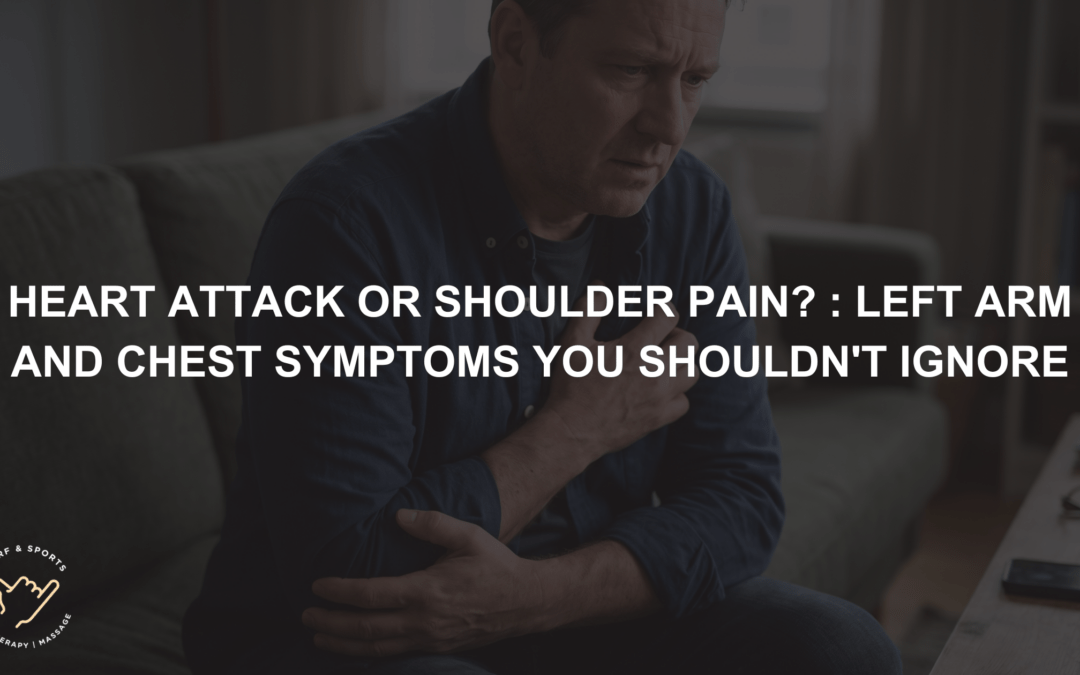
Left arm pain, right shoulder ache, jaw tightness, sudden fatigue — these symptoms can all have musculoskeletal explanations.
They can also be warning signs of a myocardial infarction. The overlap between cardiac referred pain and musculoskeletal pain is one of the most clinically significant diagnostic challenges in everyday health — not because it is rare, but because the consequences of misattributing a cardiac event to a muscle problem are severe.
This article explains the warning signs of a heart attack, why cardiac pain refers to the shoulder, arm, and jaw, how symptoms differ between men and women, and — most importantly — when to stop assessing and call Triple Zero (000) immediately.
If you are experiencing chest pain, left arm pain, jaw pain, shortness of breath, sweating, or any combination of these symptoms right now — call 000. Do not read further. Act now.
Key Takeaways
- Chest pain is the most common heart attack warning sign in both men and women — but a significant proportion of heart attacks present without chest pain at all
- Shoulder pain, left arm pain, jaw pain, and upper back pain are all recognised cardiac referred pain patterns; none of them should be dismissed as musculoskeletal without ruling out a cardiac cause
- Women are more likely to experience non-chest pain heart attack symptoms — including fatigue, nausea, jaw pain, and shortness of breath — and are more likely to attribute these symptoms to something less serious, delaying life-saving care
- When in doubt, call Triple Zero (000). Every minute of delayed treatment during a heart attack causes further cardiac muscle damage that cannot be reversed
What Happens During a Heart Attack
A heart attack — medically termed a myocardial infarction — occurs when blood flow to a section of the cardiac muscle is blocked, typically by a blood clot forming at the site of a ruptured arterial plaque in one of the coronary arteries. Without oxygen-rich blood, the affected cardiac muscle begins to die. The longer the blockage remains, the greater the damage.
Not all heart attacks are sudden and dramatic. Some begin slowly with mild discomfort that builds over minutes. Some involve severe, crushing chest pain from the outset. Some — particularly in women and people with diabetes — present with no chest pain at all, only fatigue, nausea, and a vague sense that something is wrong. The variability of presentation is precisely what makes heart attacks dangerous: they do not always look the way people expect them to.
Why a Heart Attack Causes Shoulder, Arm, and Jaw Pain
The referred pain pattern of a myocardial infarction follows a well-established neurological pathway. The heart is supplied by sensory nerve fibres that enter the spinal cord at the T1 to T4 thoracic levels. These same spinal segments also receive sensory input from the left arm, the inner forearm, the jaw, the neck, and the upper back. When the cardiac muscle sends a distress signal through these sympathetic nerve pathways, the brain — lacking precise internal maps of organ pain — interprets the signal as originating from the somatic structures sharing those spinal levels.
The result is referred pain felt in the left shoulder, left arm, left jaw, neck, and upper back — locations that feel entirely separate from the heart but are neurologically connected to it. Left arm and shoulder pain is the most recognised cardiac referral pattern, but the pain can occur on the right side, both sides simultaneously, or in the jaw and neck without any arm involvement at all. The shoulder and jaw symptoms that accompany a heart attack are not metaphorical or exaggerated — they are a genuine neurological consequence of cardiac ischaemia reaching the central nervous system through shared spinal pathways.
This is related to — but distinct from — the phrenic nerve referral mechanism that produces right shoulder pain in gallbladder and liver conditions. Cardiac referral affects predominantly the left side via the thoracic sympathetic pathways; hepatobiliary referral affects the right side via the phrenic nerve at C3–C5. Location alone is not a reliable differentiator — both can produce shoulder pain — but the two patterns have different associated features, different triggers, and completely different urgency levels.
The Full Range of Heart Attack Warning Signs
The Heart Foundation Australia identifies the following as recognised heart attack warning signs. No single symptom is required, and combinations vary significantly between individuals and events.
Common warning signs:
- Chest pain, pressure, tightness, squeezing, or heaviness — often described as a weight or an elephant sitting on the chest; may radiate to the arm, shoulder, jaw, or back
- Left arm or shoulder pain — may be the only symptom, particularly in women
- Jaw pain or toothache-like discomfort — pain radiating from the chest to the jaw via shared nerve pathways
- Shortness of breath — with or without chest pain
- Nausea or vomiting
Less common but equally important warning signs:
- Sudden dizziness or lightheadedness
- Cold sweating disproportionate to activity or temperature
- Upper back pain, particularly between the shoulder blades
- Extreme and unusual fatigue — especially a sudden onset that feels distinctly different from ordinary tiredness
- A sense of impending doom or severe unease that the person cannot explain
The presence of even one of these symptoms — particularly if it is new, sudden, or accompanied by any other symptom on this list — warrants calling Triple Zero (000). Symptoms do not need to be severe to indicate a heart attack. Many heart attacks begin with mild, intermittent discomfort that escalates.
How Heart Attack Symptoms Differ Between Men and Women
Chest pain is the most common heart attack symptom in both men and women. The clinical picture diverges significantly after that.
Men are more likely to present with the classic pattern: central chest pressure radiating to the left arm, accompanied by sweating and shortness of breath. This is the presentation most people recognise from television — and recognising it prompts faster action.
Women, and particularly women under 50, are significantly more likely to experience heart attacks without prominent chest pain. The Heart Foundation’s research on cardiovascular disease in women identifies jaw pain, upper back pain, shoulder pain, nausea, dizziness, and extreme fatigue as the symptom pattern more commonly reported by women — a constellation that is easy to attribute to stress, overwork, a pulled muscle, or a stomach complaint.
This difference in presentation has real consequences. Women experiencing heart attacks take longer to seek help than men, are less likely to recognise their symptoms as cardiac, and once in hospital, experience longer delays in receiving treatment. The less recognised a symptom pattern is, the more dangerous the delay becomes.
The practical takeaway: jaw pain, shoulder discomfort, or unusual fatigue in a woman — particularly one with known cardiovascular risk factors — should not be dismissed as obviously non-cardiac without proper consideration.
When It Feels Like a Muscle Strain, Indigestion, or Anxiety
Several common, benign conditions produce symptoms that closely resemble cardiac warning signs — and this overlap causes dangerous delays in people seeking emergency care.
Indigestion and heartburn produce chest burning and upper abdominal discomfort. A heart attack can produce similar sensations, particularly in the epigastric region. If upper abdominal or chest discomfort is accompanied by sweating, shortness of breath, or arm pain, do not wait to see if antacids help.
Muscle strain and costochondritis produce chest wall pain that is reproduced by pressing on the chest. Cardiac pain is generally not reproducible with pressure — if pushing on the chest reproduces the pain exactly, a musculoskeletal cause is more likely. But this is not a reliable rule in isolation: the presence of other warning signs overrides a palpation test.
Anxiety and panic attacks can produce chest tightness, shortness of breath, and sweating that closely mimic cardiac symptoms. A history of anxiety does not exclude a heart attack. If the pattern of symptoms is new or different from previous anxiety episodes, or if it occurs without an obvious psychological trigger, take it seriously.
One pattern worth naming directly: left arm or jaw discomfort that has been present for some time, attributed to a neck problem or gym strain, and partially responding to soft tissue treatment. That partial response is not reassurance — it is a reason to look more carefully. Cardiac symptoms can coexist with genuine musculoskeletal tension, and improvement in one does not exclude the other. Any symptom that does not follow a clear mechanical pattern — that appears at rest, that comes and goes without a physical trigger, or that is accompanied by anything from the warning sign list above — deserves a medical conversation, not another treatment session.
Cardiac Pain vs Musculoskeletal Pain: Key Distinguishing Features
Cardiac Referred Pain | Musculoskeletal Shoulder/Arm Pain | |
Location | Left arm, jaw, neck, upper back, both shoulders — often diffuse and hard to point to | Localised to a specific muscle, joint, or region |
Quality | Pressure, tightness, heaviness, squeezing, aching that radiates | Sharp with movement, dull at rest, reproduced with palpation |
Reproducible with movement? | Generally not — does not change with shoulder or neck movement | Yes — worsens or changes with specific movements |
Reproducible with pressure? | Generally not | Usually tender on palpation of the affected structure |
Onset | Can be sudden or gradual; may occur at rest | Usually follows a physical trigger — lifting, posture, activity |
Associated symptoms | Shortness of breath, sweating, nausea, dizziness, fatigue, jaw pain | None — musculoskeletal pain does not cause systemic symptoms |
Response to rest | Angina eases with rest; heart attack does not ease and may worsen | Generally improves with rest |
Action | Call 000 immediately | Myotherapist or GP depending on severity |
When to Call 000 — No Exceptions
The Heart Foundation is unambiguous: if you think you might be having a heart attack, call Triple Zero (000) immediately. Do not drive yourself to hospital. Do not wait to see if the symptoms ease. Do not take antacids to rule out indigestion first.
Call 000 now if you experience:
- Any form of chest pain, pressure, heaviness, or tightness — even mild
- Left arm, jaw, neck, upper back, or shoulder pain occurring with any other symptom on this list
- Sudden shortness of breath, particularly at rest
- Cold sweating with no obvious cause
- Sudden dizziness, lightheadedness, or loss of consciousness
- Extreme, unexplained fatigue appearing suddenly alongside any other symptom
Time is cardiac muscle. Every minute of delayed treatment during a myocardial infarction results in additional heart muscle damage that cannot be recovered. The window for effective intervention is narrow — acting quickly saves lives in a way that waiting never can.
If the symptoms turn out not to be a heart attack, the response from emergency services will reflect that. A false alarm is not a problem. A delayed call is.
The Silent Heart Attack
A silent myocardial infarction occurs without the classic warning signs that prompt people to seek help. The person may experience mild fatigue, brief shoulder discomfort, or a short episode of jaw pain and attribute each symptom to something routine. The heart attack occurs without being identified at the time.
Silent heart attacks are more common than most people realise and are diagnosed retrospectively — either during routine cardiac investigation or following a subsequent, more symptomatic event. They cause the same cardiac muscle damage as recognised heart attacks and carry the same long-term risks. People who have experienced unexplained episodes of the symptom combinations described in this article — even if they resolved — should discuss this with their GP.
Frequently Asked Questions
Can shoulder pain be the only symptom of a heart attack?
Yes. Shoulder pain — particularly in the left arm and shoulder — can occur as an isolated symptom of a heart attack, especially in women and older adults. If shoulder pain appears suddenly without a physical trigger, is accompanied by any other warning sign such as jaw discomfort, unusual fatigue, or shortness of breath, or occurs at rest rather than with activity, it warrants treating as potentially cardiac until proven otherwise. Call 000.
How do I tell the difference between cardiac shoulder pain and a muscle problem?
Musculoskeletal shoulder pain is reproduced by specific movements, pressure on the affected structure, or by a clear physical trigger such as lifting or poor posture. Cardiac referred pain to the shoulder is not typically reproducible with shoulder movement or palpation and does not follow a dermatomal or mechanical pattern. The presence of other symptoms — chest tightness, shortness of breath, sweating, jaw pain, nausea — is the strongest indicator that shoulder pain has a cardiac rather than musculoskeletal origin.
Can anxiety cause the same symptoms as a heart attack?
Yes — panic attacks and severe anxiety can produce chest tightness, shortness of breath, and a sense of impending danger that closely resembles cardiac symptoms. However, anxiety does not exclude a heart attack. If the symptom pattern is new, different from previous anxiety episodes, occurs at rest without a psychological trigger, or includes jaw or arm pain, seek emergency assessment. A prior history of anxiety is not a sufficient reason to dismiss potentially cardiac symptoms.
Are heart attack symptoms different for women?
Yes, significantly. While chest pain is the most common symptom in both sexes, women — particularly those under 50 — are more likely to experience non-chest pain symptoms including jaw pain, shoulder pain, upper back pain, nausea, and extreme fatigue. These symptoms are frequently attributed to stress, overwork, or minor illness, which delays appropriate care. Women experiencing any of these symptoms in combination, particularly with known cardiovascular risk factors, should seek emergency assessment rather than waiting.
What should I do while waiting for an ambulance?
Call 000 immediately and follow the operator’s instructions. If you have been prescribed nitroglycerin for angina, take it as directed. Chewing 300mg of aspirin (not swallowing whole) may be advised by the emergency operator if there is no allergy and no contraindication — but always follow the 000 operator’s specific guidance. Sit or lie in a comfortable position and do not exert yourself further. Do not eat or drink. Stay on the line with the emergency operator until help arrives.
Know the Signs. Act Without Delay.
Shoulder pain, jaw discomfort, unusual fatigue, and shortness of breath are not always cardiac — but the possibility that they could be is too important to dismiss. The warning signs of a heart attack are broader than most people realise, particularly for women, and the cost of delayed action is measured in cardiac muscle that cannot be recovered.
If you or someone near you is experiencing symptoms that could indicate a heart attack — call Triple Zero (000) immediately.
For information on the full spectrum of referred pain patterns — including which symptoms point to organs, which point to musculoskeletal structures, and how to begin distinguishing between them — the clinic’s guide on referred pain and symptom confusion covers the underlying neurological framework in detail.
Opening hours: Monday–Friday 08:00–19:00 | Saturday 08:00–16:00 Location: 3/14 Thomas St, Noosaville QLD 4566

About the Author
Gary Javonena is the founder of Surf & Sports Myotherapy and holds an Advanced Diploma of Myotherapy from RMIT University.
Gary’s clinical work includes the assessment of complex musculoskeletal presentations in which referred pain, postural dysfunction, and systemic contributors intersect — including cases in which gastrointestinal function directly contributes to lumbar pain patterns. Meet the full team.
Related posts

Gallbladder Problems and Right Shoulder Blade Pain – What’s Actually Going On
Gallbladder referred pain in the right shoulder blade is one of the most clinically recognised...

Kidney Pain vs Back Pain – How to Tell the Difference
Kidney pain and back pain are two of the most commonly confused symptom presentations in adults....
Constipation and Lower Back Pain – The Gut-Spine Connection Explained
Constipation and lower back pain are two of the most common physical complaints in adults, and...