

People often search deep tissue vs remedial massage when they’re sore, tight, or dealing with a stubborn problem area, and they want to book the right type of massage.
Both can be helpful. But they’re not the same thing, and the “best” choice depends on what you’re trying to get out of the session.
Quick definition: deep tissue massage
Deep tissue massage is a style of massage that uses firm pressure and slower strokes to work into deeper layers of muscle and connective tissue.
It’s commonly chosen when someone wants:
- A stronger sensation (deep pressure)
- Work through a tight knot or dense area
- Help with ongoing muscle tension
Deep tissue massage offers a “heavier” feel for many people. That said, deep pressure shouldn’t be the goal by itself.

Quick definition: remedial massage
Remedial massage is usually a more targeted treatment approach. It often starts with the therapist asking questions, checking movement, and focusing on a specific area that’s limiting you.
In practice, remedial massage focuses on:
- The affected area (and the tissues around it)
- Soft tissue that may be contributing to pain and discomfort
- Supporting function, comfort, and range of motion
If you’re dealing with a specific issue, you can read more about remedial massage and how it’s used in a clinic setting.
The main difference between remedial and deep tissue
Here’s the simplest way to think about the difference between remedial and deep:
- Deep tissue is mainly a pressure/style choice (how the work feels and how deep it goes).
- Remedial massage therapy is mainly an approach to a problem (why the work is being done and what it’s trying to change).
You can have remedial work that feels deep, and you can have deep tissue work that’s not very “remedial” (for example, a general full-body session that doesn’t target a specific goal).
Deep tissue or remedial massage: which is best for you?
Choose deep tissue massage if…
Deep tissue massage may suit you if:
- You like deep tissue work and tolerate firm pressure well
- You feel generally tight through big muscle groups (glutes, calves, upper back)
- You want a whole-body session that feels strong
It can be popular for people who lift, do manual work, or have ongoing tightness. Some people also look for it for lower back pain, but it’s important to avoid assuming all back pain is “tight muscles” that need to be pushed on.
Choose remedial massage if…
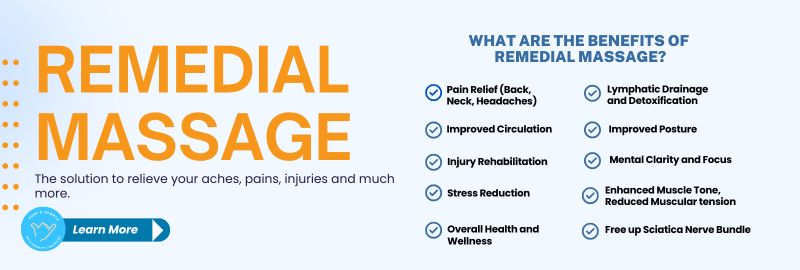
Remedial massage may suit you if:
- You have a specific complaint (for example, lower back, shoulder, hip, or calf pain)
- You want a therapist to assess and work toward a clear goal
- You’re returning to training after a flare-up or sports injuries
If you’re active and training for performance, you might also consider sports massage as another option.
What techniques might be used?
There are many different types of massage and massage techniques. Depending on what’s going on, a therapist may use:
- Trigger point therapy for a sensitive spot or knot
- Slower, deeper strokes (common in deep tissue methods)
- Work aimed at improving comfort in muscle and connective tissue
- A mix of therapeutic and relaxation-based work
A good session shouldn’t be a battle. Massage isn’t meant to feel like punishment.
Should deep tissue massage be painful?
Not necessarily.
Some discomfort can happen when working on a sensitive area, but pain that makes you tense up, hold your breath, or feel worse for days is usually a sign the pressure was too much.
A useful rule: you should be able to relax your body during the work. If you can’t, the treatment may be too aggressive for what your tissues can tolerate right now.
What about chronic pain?
With chronic pain, the goal is often to improve comfort and confidence in movement, not just “break up tight tissue.” Massage can help some people feel better short term, but it’s usually most useful when it supports a broader plan (movement, load management, sleep, and stress).
If you’re not sure what’s driving your symptoms, a more assessment-led approach like myotherapy may be a better fit.
FAQ
Is remedial massage the same as deep tissue?
No. The difference between remedial massage and deep tissue is mainly the intent. Remedial is typically goal-based and targeted. Deep tissue is a pressure/style choice.
Can remedial massage be deep?
Yes. A remedial massage therapist can use deep pressure when it suits the problem and you tolerate it.
Is deep tissue massage best for everyone?
No. Deep tissue massage depends on your goals, your sensitivity, and what you’re dealing with. For some people, lighter and more targeted work is more effective.
Book the right session
If you’re still deciding between remedial or deep tissue massage, the safest approach is to book based on your main goal and tell the therapist what you’re training for and where you feel it.
You can book via online booking.
This article is general information and isn’t a substitute for individual assessment.
Opening hours: Monday–Friday 08:00–19:00 | Saturday 08:00–16:00 Location: 3/14 Thomas St, Noosaville QLD 4566

About the Author
Gary Javonena is the founder of Surf & Sports Myotherapy and holds an Advanced Diploma of Myotherapy from RMIT University.
Gary’s clinical work includes the assessment of complex musculoskeletal presentations in which referred pain, postural dysfunction, and systemic contributors intersect — including cases in which gastrointestinal function directly contributes to lumbar pain patterns. Meet the full team.
Related posts

Remedial Massage for Seniors: Benefits for Mobility and Pain Relief
Executive Summary: Remedial massage can be genuinely useful for older adults, but only when it's...

The Science Behind Remedial Massage: Evidence-Based Benefits
Executive Summary: Remedial massage works by physically changing the state of your soft tissues...
How Remedial Massage Improves Blood Flow and Healing
Remedial massage improves blood flow by combining mechanical pressure with muscle relaxation, both...