
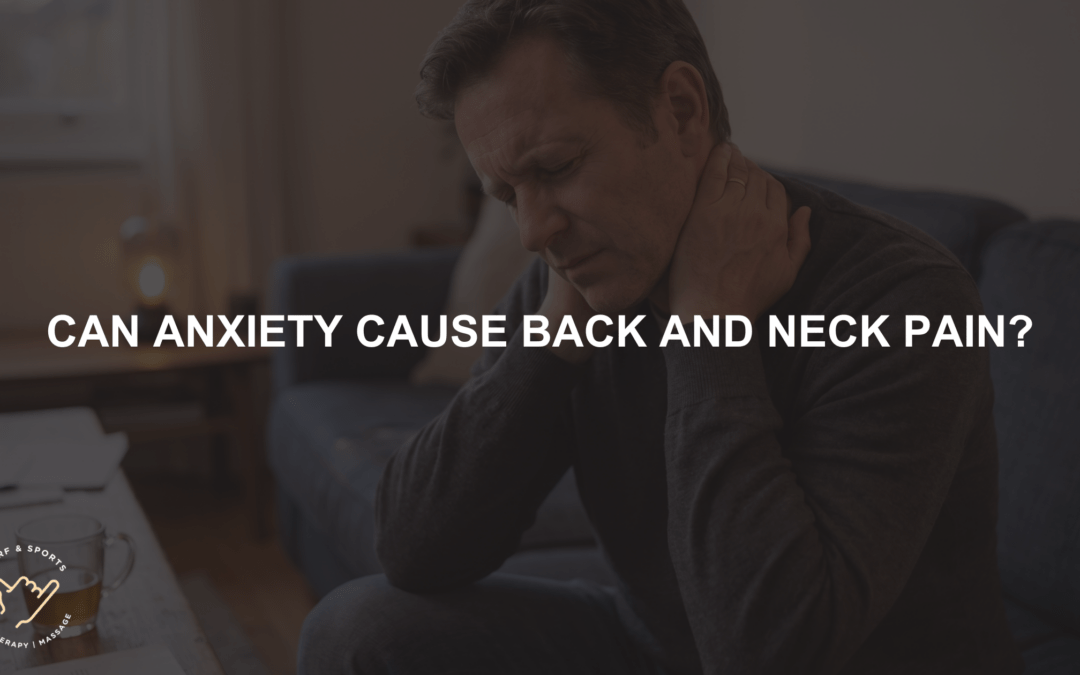
Yes — and the mechanism is more specific than most people realise. Anxiety does not simply make pain feel worse through mood alone. It triggers a cascade of physiological responses that directly load the muscles of the neck, upper back, and lower back with sustained tension.
Over time, chronic anxiety can alter how the central nervous system processes pain signals, making the body more sensitive to stimuli it would normally filter out.
For people who train hard and lead active lives — the kind of life that is common across the Sunshine Coast — this pattern is easy to miss, because there are always obvious physical explanations for neck stiffness or a tight lower back. The anxiety contribution sits quietly underneath them.
Key Takeaways
- Anxiety activates the fight-or-flight response, which floods the body with cortisol and adrenaline and drives sustained muscle tension — particularly through the upper trapezius, cervical spine, and lumbar paraspinals
- Chronic anxiety can produce central sensitisation: a state in which the nervous system itself becomes hypersensitive, amplifying pain signals from structures that would not normally generate significant discomfort
- The relationship between anxiety and pain is bidirectional — pain increases anxiety, which increases pain — and breaking this cycle requires addressing both sides
- Myotherapy can address the muscular component of anxiety-driven neck and back pain; the anxiety itself warrants assessment and support from a GP or mental health professional
What Anxiety Does to the Body
Anxiety is a mental health condition — but its effects are thoroughly physical. When the brain perceives a threat, whether real or anticipated, the autonomic nervous system triggers the fight-or-flight response. Adrenaline and cortisol flood the bloodstream. Heart rate rises. Breathing shallows. And muscles contract — particularly the muscles of the neck, shoulders, and back — preparing the body to respond to danger.
In a genuine emergency, this response is functional. The tension releases once the threat passes. The problem with anxiety disorders is that the threat rarely passes. The nervous system stays activated. The muscles stay contracted. And what begins as a physiological response to perceived danger gradually becomes a chronic pattern of muscular loading that produces real, persistent neck and back pain — not as a side effect of anxiety, but as a direct physical consequence of it.
Three Ways Anxiety Loads the Neck and Back
The Upper Trapezius and Cervical Spine
The upper trapezius — the muscle running from the base of the skull across the top of the shoulders — is among the most anxiety-responsive muscles in the body. During sustained stress and anxiety, the upper trapezius holds a low-level contraction that rarely fully releases. People describe it as tension that lives at the top of their shoulders, a sense of carrying weight around the neck, or a stiffness that is always there regardless of how much they stretch.
This sustained contraction produces myofascial trigger points that refer pain into the neck, the base of the skull, and behind the eye. The cervical spine, loaded asymmetrically by this chronic holding pattern, develops joint stiffness and reduced range of motion. Tension headaches are a frequent companion — the same trigger point activity in the upper cervical musculature that produces neck pain also generates the characteristic band-like headache that many anxious people experience daily.
The Jaw and Its Downstream Effect on the Neck
Jaw clenching during periods of anxiety and stress — often unconsciously, and frequently during sleep — loads the temporomandibular joint and the muscles of mastication. The masseter, temporalis, and medial pterygoid all connect biomechanically to the cervical spine through the sternocleidomastoid and suboccipital muscles. A chronically braced jaw produces tension that travels down the neck and into the upper back, contributing to a pattern of stiffness and pain that starts overnight and persists through the day.
People who wake with a stiff neck or a headache that has no obvious cause — and who are also managing ongoing stress or anxiety — are often experiencing this jaw-to-neck transfer rather than a pillow or sleep position problem.
The Lumbar Paraspinals and the Stress Posture
Sustained anxiety changes posture. The protective rounding of the shoulders, the forward head position, and the slight forward lean that the fight-or-flight response produces place increased demand on the lumbar erectors, quadratus lumborum, and thoracolumbar fascia. Over a full working day in this posture, or across weeks and months of chronic anxiety, the lower back accumulates the same kind of myofascial tension and trigger point activity that is more commonly attributed to desk work or physical loading.
Stress and chronic anxiety directly list muscular tension and back pain among their documented physical symptoms — yet many people who present with lower back pain have never been asked about their stress levels as part of the clinical picture.
Central Sensitisation: When Anxiety Changes How Pain Is Processed
Beyond muscle tension, chronic anxiety can alter pain processing at the level of the central nervous system through a mechanism called central sensitisation. In central sensitisation, the spinal cord and brain become hypersensitive to incoming pain signals — the threshold drops, so stimuli that would previously have been filtered out or experienced as mild discomfort now register as significant pain.
A PMC narrative review on central sensitisation in chronic low back pain identifies anxiety as one of the psychological factors consistently associated with higher central sensitisation scores. This matters clinically because it helps explain why two people with similar levels of muscular tension can have vastly different pain experiences — and why, for someone with chronic anxiety, soft tissue treatment alone often provides only partial relief. The tissue changes are real and treatable, but the nervous system’s amplified response to those changes persists until the anxiety is also being addressed.
This is not a psychological explanation for physical pain — it is a physiological one. Central sensitisation involves measurable changes in how nociceptive neurons in the central nervous system respond to input. The pain is real. Its intensity is shaped by the nervous system state accompanying it.
The Trap: When Pain and Anxiety Feed Each Other
One of the more clinically significant aspects of anxiety-related neck and back pain is the bidirectional cycle it creates. Anxiety drives muscle tension and central sensitisation, which produces pain. Pain — particularly when it is persistent, unexplained, or interfering with activity — increases anxiety. The heightened anxiety further loads the muscles and sensitises the nervous system. The pain intensifies.
For active people on the Sunshine Coast, this cycle has a particular edge. A triathlete who cannot train because of neck pain, a surfer who is restricted by back stiffness, a runner whose lower back won’t settle — these are people for whom the inability to exercise removes one of the primary tools they use to manage stress. The physical restriction increases the anxiety, which perpetuates the physical symptoms, which further restricts activity. The cycle is self-reinforcing and can be difficult to interrupt without deliberately addressing both its physical and psychological dimensions.
Anxiety-Driven Neck and Back Pain vs Purely Mechanical Pain
Anxiety-Driven | Mechanical | Combined | |
Onset pattern | Gradual; correlates with stress levels; often worse during or after periods of high anxiety | Follows a physical trigger — posture, lifting, activity | Both patterns present simultaneously |
Location | Upper trapezius, cervical spine, jaw region; sometimes lumbar | Specific to loaded structure — lumbar, SI joint, disc | Widespread; multiple areas at once |
Response to massage | Improves temporarily; returns when stress levels rise again | Responds well with sustained improvement | Partial improvement; requires both soft tissue treatment and anxiety management |
Time of day | Often worse in the morning or after periods of inactivity; may coincide with anxious periods | Worsens with specific activities or prolonged postures | Variable |
Associated symptoms | Headaches, jaw tension, sleep disruption, fatigue, difficulty relaxing | Restricted spinal movement, positional pain | Mix of both |
What helps | Addressing both the soft tissue component and the anxiety | Myotherapy or physiotherapy for the mechanical cause | Integrated approach — manual therapy alongside anxiety support |
What Myotherapy Can and Cannot Address
The muscular component of anxiety-driven neck and back pain — the trigger points, the myofascial restrictions, the postural loading patterns — responds well to hands-on treatment. At Surf & Sports Myotherapy in Noosaville, assessment of neck and back pain includes consideration of stress and anxiety as contributing factors to the clinical picture. Treatment addresses the accumulated soft tissue changes through myotherapy, including trigger point therapy through the upper trapezius, cervical musculature, and lumbar paraspinals, alongside joint mobility work where stiffness has developed secondary to chronic holding patterns.
What manual therapy cannot do is address the anxiety itself. If anxiety is driving the pattern, treating the muscles provides relief — but the tension returns. The most durable outcomes come when soft tissue treatment is happening alongside genuine anxiety management: whether that is psychological therapy, lifestyle change, movement, breathwork, medication, or some combination. A GP is the right starting point for establishing what that support should look like.
The neck stiffness, back pain, and headaches that accompany chronic anxiety are worth treating — they are real, they affect quality of life, and reducing the physical burden of those symptoms can itself reduce anxiety levels. But a treatment plan that only addresses the body, without acknowledgment of the nervous system state driving it, will keep delivering the same partial result.
Frequently Asked Questions
How do I know if my neck pain is from anxiety or a physical problem?
The two are not mutually exclusive — many people have both. Anxiety-driven neck tension tends to correlate with stress levels: it worsens during difficult periods and eases somewhat when circumstances improve. It is often bilateral, sitting across the tops of both shoulders and into the base of the skull, and it may come with headaches and jaw tension. Mechanical neck pain tends to be more localised, more clearly related to a physical trigger, and more directional in how it responds to movement. If your neck pain has no clear physical cause, worsens with stress, and keeps returning despite treatment, the anxiety contribution is worth exploring with a GP or health professional.
Can anxiety cause lower back pain without any physical cause?
Yes. Sustained anxiety-driven muscle tension loads the lumbar paraspinals and alters posture in ways that generate genuine lower back pain without any structural injury. Central sensitisation in anxious individuals can also amplify normal levels of lumbar muscle fatigue into significant pain. This does not mean the pain is imagined — it means the nervous system is generating a pain experience that exceeds what the tissue alone would produce. Both components are real and both can be addressed.
Will treating my neck and back pain help my anxiety?
Reducing physical pain and tension can meaningfully lower the body’s overall stress burden, which may have a modest positive effect on anxiety levels — particularly if the pain has been restricting physical activity. Exercise is one of the most evidence-supported approaches to managing anxiety, and removing the physical barrier to movement can restore access to it. However, soft tissue treatment is not a substitute for proper anxiety assessment and support.
Why does my neck get so stiff when I’m stressed even though I exercise regularly?
Exercise addresses the cardiovascular and physiological aspects of the stress response, but it does not always fully discharge the muscular holding patterns that chronic anxiety produces — particularly in the upper trapezius, jaw, and cervical spine. Many highly active people carry significant neck and shoulder tension because the anxiety-driven holding pattern operates independently of their fitness level. The tension is neurological rather than a consequence of physical deconditioning, which is why it persists in otherwise fit individuals.
Is it worth getting a massage for anxiety-related muscle tension?
Yes — with realistic expectations. Massage reduces the immediate muscular tension and trigger point activity effectively and can provide meaningful short-term relief. Regular treatment as part of a broader approach — including whatever anxiety management strategies are appropriate for the individual — produces more sustained results than sporadic sessions used as a crisis response. If tension returns consistently within a short period after treatment, that pattern itself is useful clinical information about the degree of anxiety driving it.
The Physical Part of Anxiety Is Worth Taking Seriously
Neck stiffness, jaw tension, upper back tightness, and chronic lower back pain are not just symptoms that happen to accompany anxiety — in many cases they are anxiety, expressed through the body. Understanding that connection changes how both sides of the picture get managed.
If you are dealing with persistent neck or back tension on the Sunshine Coast and want an assessment of the soft tissue component, the team at Surf & Sports Myotherapy in Noosaville can help identify what is driving the pattern and what is likely to produce lasting improvement.
Book your appointment online or call 0423 729 694. 694.
Opening hours: Monday–Friday 08:00–19:00 | Saturday 08:00–16:00 Location: 3/14 Thomas St, Noosaville QLD 4566

About the Author
Gary Javonena is the founder of Surf & Sports Myotherapy and holds an Advanced Diploma of Myotherapy from RMIT University.
Gary’s clinical work includes the assessment of complex musculoskeletal presentations in which referred pain, postural dysfunction, and systemic contributors intersect — including cases in which gastrointestinal function directly contributes to lumbar pain patterns. Meet the full team.
Related posts
How Remedial Massage Improves Blood Flow and Healing
Remedial massage improves blood flow by combining mechanical pressure with muscle relaxation, both...

Combining Remedial Massage with Dry Needling: Enhanced Results
Remedial massage and dry needling target the same problem from two different angles, and when used...
How Remedial Massage Therapists Assess Muscle Imbalances
A remedial massage assessment is what separates a targeted treatment plan from a generic rubdown....