
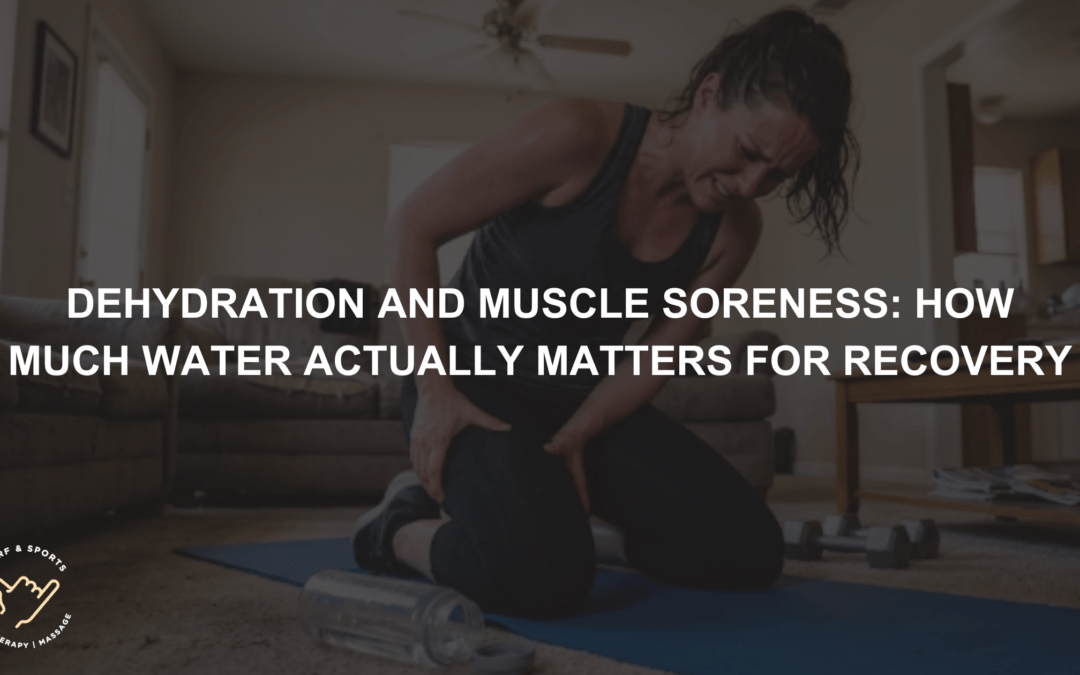
The relationship between hydration and muscle soreness is more specific than the general advice to “drink more water” tends to suggest. Delayed onset muscle soreness, the deep ache that sets in 24 to 72 hours after demanding exercise, is driven by exercise-induced tissue damage and the inflammatory response that follows it.
Dehydration does not cause DOMS directly, but it amplifies its severity through three distinct physiological pathways: reduced blood flow to damaged tissue, elevated muscle temperature during exercise, and fascial dehydration that stiffens the connective tissue surrounding the muscles.
For people training in Queensland’s heat, all three pathways operate simultaneously during and after outdoor sessions in ways that make hydration one of the most controllable recovery variables available.
Key Takeaways
- Dehydration worsens DOMS severity through reduced blood volume, impaired nutrient and waste clearance from damaged muscle tissue, and elevated muscle temperatures during exercise in the heat
- Research published in PMC confirms that dehydrated individuals performing eccentric exercise experience exacerbated skeletal muscle damage compared to euhydrated counterparts
- Fascia, the connective tissue now considered a primary site of DOMS-related damage, requires adequate hydration to maintain its mechanical properties; dehydrated fascia becomes stiffer and less extensible
- Rehydration is not only about water: sodium, potassium, and other electrolytes lost in sweat affect muscle cell function and recovery independently of fluid volume alone
What Happens to Muscle During Hard Exercise
Delayed onset muscle soreness occurs when exercise, particularly eccentric muscle actions like downhill running, heavy squats, or the landing phase of jumping, produces microdamage to the muscle fibres and surrounding connective tissue. The structural disruption initiates an inflammatory response: fluid shifts into the damaged tissue, inflammatory mediators accumulate, and the affected area becomes sensitised. The characteristic aching and stiffness of DOMS reflects this inflammatory process rather than the tissue damage itself, which is why symptoms peak 24 to 72 hours after exercise rather than immediately.
Importantly, recent research suggests that DOMS and exercise-induced muscle damage are more closely associated with disruption to connective tissue, specifically fascia, than to the muscle fibres themselves. Fascia, the sheets and layers of connective tissue surrounding every muscle group, contains its own sensory nerve supply and responds to mechanical loading and damage in ways that produce soreness patterns that outlast muscle fibre repair. The implication for hydration is direct: fascia’s mechanical properties are highly dependent on its water content.
Three Ways Dehydration Makes DOMS Worse
Reduced Blood Flow and Impaired Tissue Clearance
Blood delivers oxygen and nutrients to damaged muscle tissue and clears the inflammatory mediators and metabolic by-products generated by exercise. When dehydration reduces blood volume, this delivery-and-clearance function is compromised, damaged tissue receives less support, and the waste products driving inflammation remain concentrated in the area for longer.
Research published in PMC found that blood flow to exercising muscles is significantly reduced under dehydration due to reductions in blood pressure and perfusion pressure. The same study confirmed that a dehydrated individual performing eccentric exercise experiences exacerbated skeletal muscle damage , structural, contractile, and enzymatic protein disruption beyond what occurs under euhydrated conditions. The mechanism is partly this reduced perfusion: the muscle’s ability to sustain eccentric loading is compromised when blood delivery falls short, and the resulting damage is greater.
In a Queensland training context, outdoor sessions, warm weather, sweating that begins before exercise intensity demands it , the perfusion deficit from dehydration accumulates across a session in ways that do not require severe dehydration to matter. Even a 2% body mass loss from sweat has measurable effects on cardiovascular performance and muscle blood flow.
Elevated Muscle Temperature
A separate PMC study on the combined effects of hyperthermia and dehydration on DOMS found that exercise heat stress adversely affects muscle injury and the accompanying delayed onset soreness. Dehydration impairs thermoregulation, the body’s ability to manage heat through sweat evaporation , allowing muscle temperature to rise higher than it would in a hydrated state performing the same work.
Elevated muscle temperature amplifies exercise-induced muscle damage through enzymatic activity changes at the cellular level. The proteins responsible for muscle contraction and structural integrity are temperature-sensitive, and higher intramuscular temperatures during eccentric loading increase the degree of disruption they sustain. The result is greater tissue damage per unit of exercise, and a more significant inflammatory response in the 24 to 72 hours following the session.
For Sunshine Coast athletes training outdoors in summer—runners, cyclists, triathletes, surfers , this mechanism combines with Queensland’s ambient heat to produce DOMS that is disproportionate to the effort expended. Adequate pre-exercise hydration reduces this temperature amplification effect.
Fascial Dehydration and Stiffness
Fascia is approximately 70% water by composition. Its mechanical properties , the ability to slide, glide, and transmit force between muscle groups , depend on this water content to maintain optimal viscosity and extensibility. When systemic dehydration draws water from the fascial matrix, the tissue stiffens. The ground substance that keeps fascial layers separated and mobile becomes more viscous, adhesions between adjacent tissue layers develop more readily, and the fascial restriction that both produces and amplifies DOMS-related stiffness is greater.
This is the hydration mechanism most directly relevant to manual therapy. Dehydrated fascia presents differently in assessment and treatment; it is less responsive to myofascial release, holds tension more stubbornly, and returns to restriction faster following treatment than adequately hydrated fascia. People who present for soft tissue treatment while chronically underhydrated will notice that the results are shorter-lived because the tissue substrate underlying the restriction has not been addressed.
How Much Water Actually Matters
The honest clinical answer is that there is no universally applicable daily water target that works across different body sizes, exercise volumes, climates, and sweat rates. The commonly cited figures, 2 litres a day, eight glasses, are population averages that serve as rough baselines for sedentary adults in temperate conditions. They are not calibrated for someone running 50 kilometres a week in Queensland summer.
A more useful practical framework:
Monitor urine colour. Pale yellow indicates adequate hydration. Dark yellow or amber indicates insufficient fluid intake for current demands. Clear and colourless frequently indicates over-hydration, which has its own implications for electrolyte balance.
Account for sweat rate. A practical approach is weighing before and after a training session , each kilogram of body mass lost represents approximately one litre of fluid deficit. This accounts for individual sweat rates more accurately than any general guideline.
Hydrate before, during, and after. Beginning a session already dehydrated means the temperature and perfusion mechanisms described above are active from the first minutes of effort. Pre-session hydration is not optional for outdoor training in Queensland heat.
Spread intake through the day. Drinking one large volume of fluid immediately before a session is less effective than maintaining hydration consistently. The body’s absorption capacity is finite, and surplus fluid is excreted rather than retained in tissue.
Electrolytes: When Water Alone Is Not Enough
Sweat contains sodium, potassium, chloride, and trace amounts of calcium and magnesium. Replacing fluid volume without replacing the electrolytes lost with it creates a dilution effect , blood sodium drops, which can paradoxically impair muscle function even in the presence of adequate fluid volume.
For sessions lasting longer than 60 to 90 minutes, particularly in heat, electrolyte replacement becomes relevant alongside fluid intake. Sodium is the electrolyte lost in greatest quantity in sweat and is the most important to replace in prolonged exercise. Potassium and magnesium play complementary roles in muscle cell function and recovery. The relationship between magnesium and muscle cramps covers the electrolyte picture specific to cramping and involuntary contraction , a distinct but related presentation to DOMS that is also influenced by sweat loss and recovery nutrition.
For most active people in training rather than prolonged competition, food and drink combined provide adequate electrolyte replacement. Electrolyte supplements become more relevant at higher sweat volumes, longer durations, or when dietary intake is genuinely insufficient.
Hydration and Soft Tissue Treatment
People who come for remedial massage while dehydrated are working against the treatment. Fascial work and myofascial release require adequate tissue hydration to produce and maintain the results of the session, the ground substance needs water to respond to applied pressure and to sustain improved tissue mobility after the hands are removed. Drinking adequately in the 24 to 48 hours before a treatment session is as relevant to the outcome as the treatment itself.
Post-massage hydration is similarly practical, the soft tissue mobilisation of a treatment session shifts fluids through the tissue in a way that is supported by adequate water intake afterward. This is not about “flushing toxins,” a claim without meaningful clinical basis, it is about providing the fluid substrate that allows the fascial and muscular changes from treatment to stabilise.
For active people on the Sunshine Coast managing DOMS through a combination of training load management, nutrition, and soft tissue care, hydration sits alongside all of these rather than substituting for any of them. The team at Surf & Sports Myotherapy regularly incorporates hydration as part of the recovery conversation, it is one of the variables that most directly affects how quickly tissue changes hold and how long the benefit of a session lasts.
Frequently Asked Questions
Does drinking water actually reduce muscle soreness?
Adequate hydration reduces the severity of DOMS by supporting blood flow to damaged tissue, maintaining muscle temperature regulation during exercise, and preserving fascial extensibility. It does not prevent DOMS entirely, the exercise-induced tissue damage that triggers it is normal and necessary for adaptation. What hydration changes is how severe the inflammatory response becomes and how efficiently the recovery process proceeds.
How much water should I drink after a hard training session?
Replace approximately 1.5 times the fluid lost through sweat, so if you lost 1 kg of body mass during training, aim for around 1.5 litres over the following few hours rather than attempting to drink it all at once. Spreading rehydration over time is more effective than drinking a large volume rapidly, which triggers faster renal excretion. Including electrolytes in your post-session nutrition supports fluid retention at the cellular level.
Can dehydration cause muscle tightness between sessions?
Yes. Chronic mild dehydration , not acute dehydration, but consistently low fluid intake relative to daily needs , contributes to fascial stiffness and reduced tissue extensibility that persists between training sessions. People who find that massage results do not hold as long as expected, or who carry persistent stiffness despite adequate recovery time, are worth asking about daily fluid intake. It is one of the simpler variables to improve and can produce noticeable differences in tissue mobility.
Does caffeine from coffee cause dehydration that worsens recovery?
Moderate caffeine intake , up to three to four cups of coffee daily , does not produce meaningful dehydration in habitual caffeine consumers. The mild diuretic effect of caffeine is offset by the fluid volume of the beverage itself in most circumstances. Very high caffeine intake, or caffeine combined with significant heat and exercise, can contribute to fluid deficit at the margins , but for most active adults, moderate coffee consumption is not a meaningful contributor to dehydration-related recovery problems.
Is sports drink better than water for recovery?
For sessions under 60 minutes of moderate intensity, water is sufficient for most people. For longer, higher-intensity sessions , particularly in heat , electrolyte replacement becomes relevant, and drinks containing sodium alongside carbohydrate support both fluid retention and glycogen replenishment. The choice between water and a sports drink depends on session duration, intensity, ambient temperature, and individual sweat rate rather than a universal recommendation.
Recovery Is Built in the Hours Between Sessions
DOMS is not a problem to be solved on the day it peaks , it is shaped by every decision made in the 24 to 48 hours before the exercise that caused it. Hydration is one of those decisions, and it is one of the most accessible levers active people have for managing how hard recovery is on their body. Getting this right does not eliminate the discomfort of hard training. It does mean the body is better equipped to handle it, and that the work invested in treatment and recovery actually holds.
If you are on the Sunshine Coast and want support managing training-related soreness and recovery, the team at Surf & Sports Myotherapy in Noosaville can assess what is driving the pattern and what adjustments , in training, in treatment, and in recovery habits , are likely to make the most difference.
Book your appointment online or call 0423 729 694.
Opening hours: Monday–Friday 08:00–19:00 | Saturday 08:00–16:00 Location: 3/14 Thomas St, Noosaville QLD 4566

About the Author
Gary Javonena is the founder of Surf & Sports Myotherapy and holds an Advanced Diploma of Myotherapy from RMIT University.
Gary’s clinical work includes the assessment of complex musculoskeletal presentations in which referred pain, postural dysfunction, and systemic contributors intersect — including cases in which gastrointestinal function directly contributes to lumbar pain patterns. Meet the full team.
Related posts

How Remedial Massage Improves Blood Flow and Healing
Remedial massage improves blood flow by combining mechanical pressure with muscle relaxation, both...

Combining Remedial Massage with Dry Needling: Enhanced Results
Remedial massage and dry needling target the same problem from two different angles, and when used...

How Remedial Massage Therapists Assess Muscle Imbalances
A remedial massage assessment is what separates a targeted treatment plan from a generic rubdown....