

Executive Summary: Remedial massage is generally considered safe during pregnancy, but what’s appropriate changes from one trimester to the next, and it should always start with a conversation about your specific pregnancy rather than a standard treatment plan. Positioning, pressure and the areas a therapist works on all need to be adjusted as pregnancy progresses. Done with a qualified therapist who knows your history, it can genuinely help with back pain, swelling and stress, but it isn’t something to book in without checking your own circumstances first.
Key Takeaways:
- Remedial massage during pregnancy is generally safe, but it needs to be adapted trimester by trimester rather than treated as one fixed approach.
- Many therapists prefer to wait until after the first trimester before starting regular sessions, as a precaution rather than because of firm evidence of harm.
- Positioning changes significantly by the second and third trimester, since lying flat on your back for extended periods isn’t recommended later in pregnancy.
- Always check with your GP or midwife first if you have a high-risk or complicated pregnancy, and choose a therapist who asks about your pregnancy before touching a table.

Remedial massage during pregnancy is a modified form of remedial massage that adjusts pressure, positioning and technique to suit each stage of pregnancy, with the goal of easing back pain, swelling and muscle tension without introducing unnecessary risk. It isn’t the same treatment given outside of pregnancy with lighter pressure. It’s a different approach, shaped by what’s safe and useful at each trimester, and it should always begin with an honest conversation about your health history and how the pregnancy is progressing.
First Trimester: Why Many Therapists Wait
Miscarriage risk is naturally highest in the first trimester regardless of massage, and there’s no strong evidence that remedial massage causes it. Even so, many massage therapists take a cautious approach and prefer to hold off on deep or targeted work until after around 12 to 14 weeks, simply because it’s difficult to separate cause from coincidence if something goes wrong early on. If you do want treatment in the first trimester, gentle, general relaxation techniques are the more common approach, and it’s worth checking with your GP or midwife beforehand, particularly if you’ve had a previous pregnancy complication.
Second Trimester: Where Remedial Massage Tends to Help Most
This is often when remedial massage does the most good. As the body carries more weight forward, lower back pain, hip tightness and postural strain tend to increase, and targeted work on the muscles supporting the spine and pelvis can make a real difference. Positioning starts to matter more here too. Lying flat on your back for long periods isn’t recommended once the uterus is heavier, since it can put pressure on major blood vessels, so most therapists use side-lying positions with supportive pillows or a pregnancy-specific table instead.
Third Trimester: Adjusting for Comfort and Swelling
By the third trimester, comfort and circulation become the priority. Swelling in the legs and feet is common, and gentle massage can help improve blood flow and ease some of the discomfort, though any sudden or severe swelling should be checked by a GP or midwife rather than treated as a massage issue. Side-lying positioning is standard by this stage, sessions are often shorter, and pressure is generally lighter around the abdomen and lower legs.
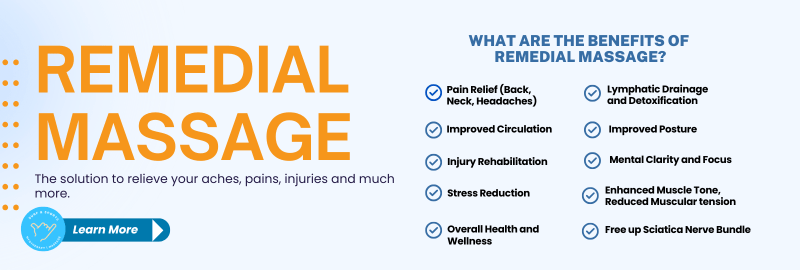
What Remedial Massage Can Help With During Pregnancy
- Lower back and pelvic pain. The extra weight and shifted posture of pregnancy put real strain on the lower back, and targeted muscle work can ease that tension.
- Leg and foot swelling. Gentle techniques can support circulation in the lower body, particularly in the second and third trimester.
- Stress and anxiety. Pregnancy comes with its own emotional load, and the relaxation response from massage isn’t just physical.
- Sleep quality. Easing muscle tension and reducing stress hormones both tend to support better sleep as pregnancy progresses.
Trimester at a Glance
Trimester | General Approach | Key Consideration |
First (weeks 1-12) | Gentle, general relaxation only, if any treatment at all | Many therapists wait until after this trimester as a precaution |
Second (weeks 13-27) | Targeted work on back, hips and posture | Side-lying positioning replaces lying flat on the back |
Third (weeks 28+) | Lighter pressure, shorter sessions, focus on comfort | Watch for and report sudden swelling to a GP or midwife |
What to Avoid or Ask About Before Booking
A properly run session should always start with questions, not assumptions. Tell your therapist about your due date, any complications like pre-eclampsia or a history of clots, and whether your GP or midwife has flagged anything specific. Deep pressure directly on the abdomen is avoided throughout pregnancy, and a therapist unfamiliar with pregnancy massage may not know which positions or pressure points to steer clear of, so it’s worth confirming they have experience with pregnant clients before your first session.
Frequently Asked Questions
What areas cannot be massaged during pregnancy?
Deep, direct pressure on the abdomen is avoided throughout pregnancy, and a qualified therapist will also adjust positioning and pressure around the lower back and legs depending on your trimester and any individual concerns.
What kind of massage is safe while pregnant?
Gentle, well-communicated remedial or relaxation massage from a therapist who knows you’re pregnant is generally safe, with technique adjusted for your trimester rather than a fixed, one-size-fits-all approach.
Why is it not recommended to get a massage in the first trimester?
It’s less about known harm and more about caution, since miscarriage risk is naturally highest in early pregnancy and it’s hard to rule out coincidence. Many therapists prefer to wait or keep first-trimester treatment very gentle as a result.
Getting Started Safely
According to Pregnancy, Birth and Baby, massage during pregnancy is generally considered safe when performed by a suitably trained therapist who adapts technique to each trimester. If you’re dealing with back pain, swelling or stress and want to know what’s actually appropriate for where you’re at, start with a conversation rather than a generic booking. You can read more about our approach to remedial massage for pregnancy-related back pain, or book directly through online booking and let us know your due date and any concerns when you do.
Opening hours: Monday–Friday 08:00–19:00 | Saturday 08:00–16:00 Location: 3/14 Thomas St, Noosaville QLD 4566

About the Author
Gary Javonena is the founder of Surf & Sports Myotherapy and holds an Advanced Diploma of Myotherapy from RMIT University.
Gary’s clinical work includes the assessment of complex musculoskeletal presentations in which referred pain, postural dysfunction, and systemic contributors intersect — including cases in which gastrointestinal function directly contributes to lumbar pain patterns. Meet the full team.
Related posts

Remedial Massage for Seniors: Benefits for Mobility and Pain Relief
Executive Summary: Remedial massage can be genuinely useful for older adults, but only when it's...

The Science Behind Remedial Massage: Evidence-Based Benefits
Executive Summary: Remedial massage works by physically changing the state of your soft tissues...
How Remedial Massage Improves Blood Flow and Healing
Remedial massage improves blood flow by combining mechanical pressure with muscle relaxation, both...