
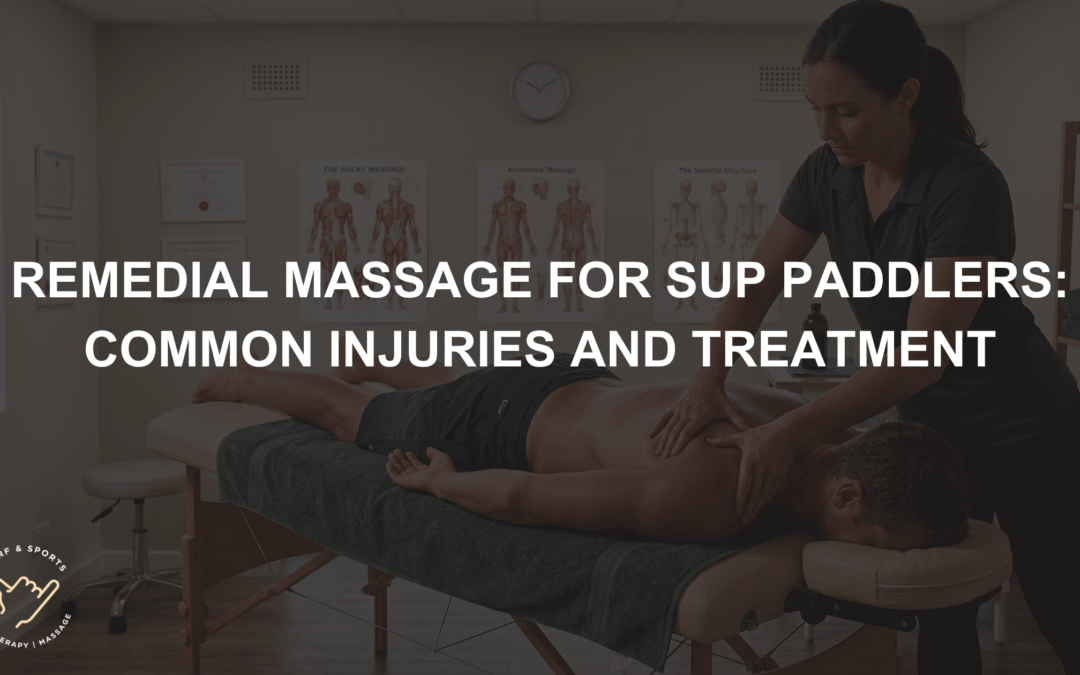
Remedial massage for SUP paddlers addresses the specific shoulder overuse, lower back strain, and soft tissue injuries that accumulate through stand-up paddleboarding’s unique physical demands.
Stand-up paddleboarding requires simultaneous upperbody propulsion, rotational trunk movement, and continuous lowerbody stabilization on an unstable surface—a combination that loads the shoulder joint, rotator cuff muscles, and lumbar spine in ways that differ meaningfully from most other water sports.
At Surf & Sports Myotherapy in Noosaville, the team treats SUP paddlers across the Sunshine Coast, applying targeted manual therapy to the muscle groups and connective tissue structures most affected by repetitive paddling on the water.
Key Takeaways
- Published epidemiological research identifies the shoulder and upper arm as the most frequently injured body location in SUP, accounting for nearly one third of all major injuries, with the lower back a significant secondary site
- Remedial massage targets the rotator cuff muscles, latissimus dorsi, and thoracic spine—the structures most loaded by the SUP paddle stroke
- The instability of stand-up paddleboarding adds a continuous stabilisation demand through the trunk, hip, and knee not present in seated paddling sports
- Regular remedial massage as part of a structured training program reduces soft tissue overload before it becomes a chronic pain problem
Why Stand-Up Paddleboarding Produces Specific Soft Tissue Injuries
Stand-up paddleboarding is a full-body sport with a deceptively complex injury profile. The paddle stroke drives repeated shoulder flexion, internal rotation, and trunk rotation against water resistance. Sustaining this pattern across a long session—or accumulating hours of paddling across a training week—creates a predictable overuse load on the shoulder joint, rotator cuff, and the muscles of the upper back and arm.
A peer-reviewed epidemiological study published in the American Journal of Sports Medicine found that the shoulder and upper arm accounted for 32.9% of all major SUP injuries, with the lower back responsible for a further 14.3%. Muscle and tendon injuries made up more than half of all recorded injuries, and endurance paddling was the most frequently reported injury mechanism. In other words, it is the volume of repetitive paddling—not a single acute event— that drives most SUP-related soft tissue problems.
The instability of the paddleboard adds a secondary injury layer not present in kayaking or outrigger paddling. Maintaining a stable standing position on a moving board recruits the deep stabiliser muscles of the trunk, hip, and knee continuously throughout every session. When these stabiliser systems fatigue, the body compensates through altered posture and movement patterns—increasing load on structures that are not equipped to absorb it.
The Most Common Soft Tissue Injuries in SUP Paddlers
Shoulder Impingement and Rotator Cuff Strain
Shoulder impingement syndrome and rotator cuff strain are the defining overuse injuries of stand-up paddleboarding. The paddle stroke requires the shoulder to move through a wide range of motion under load, with each stroke demanding coordinated activation of the supraspinatus, infraspinatus, teres minor, and subscapularis—the four rotator cuff muscles responsible for stabilising the shoulder joint during dynamic movement.
Repetitive overhead and forward shoulder movement compresses the rotator cuff tendons against the acromion, particularly when fatigue reduces the quality of scapular control. Over time, this compression pattern produces shoulder pain, a loss of range of motion, and progressive tendon irritation that worsens with continued paddling.
Lower Back Strain
The SUP paddle stroke generates its power through trunk rotation — a movement that requires both mobility and stability through the lumbar and thoracic spine. Paddlers with restricted thoracic mobility or weak core musculature tend to generate rotational force through the lumbar spine instead, placing excessive stress on the lower back across a long session.
Lower back strain in SUP paddlers is typically a soft tissue condition driven by muscular fatigue and postural load rather than structural damage. It responds well to hands-on treatment that addresses both the lumbar musculature and the thoracic and hip restrictions that force the lower back to compensate.
Elbow and Forearm Overuse
The elbow and forearm are the third most commonly injured area in SUP, accounting for approximately 11.8% of all major injuries in the research literature. Sustained grip on the paddle handle, combined with the repetitive load transfer from blade to body across each stroke, creates forearm extensor and flexor overuse that can progress to lateral epicondylalgia (tennis elbow) or medial tendinopathy if not managed.
Knee Instability and Lateral Pain
Maintaining balance on a paddleboard demands continuous activation of the knee stabilizers—particularly the vastus medialis and the surrounding soft tissue structures that control lateral knee tracking. Paddlers who spend long sessions on the board can develop knee pain related to fatigue-driven instability, particularly through the lateral compartment. Iliotibial band tension and patellofemoral load are both common presentations in regular SUP participants.
How Remedial Massage Treats SUP-Related Injuries
Remedial massage is a form of manual therapy that assesses and treats the specific musculoskeletal dysfunction driving a paddler’s symptoms—not a generic session applied to whatever is sore. At Surf & Sports Myotherapy, the therapist evaluates the paddler’s injury pattern, training volume, and any compensatory movement habits before treatment begins.
Releasing the Rotator Cuff and Shoulder Complex
Myofascial trigger points within the infraspinatus, teres major, and subscapularis are a consistent finding in SUP paddlers presenting with shoulder pain. These trigger points produce a referred pain pattern that travels into the shoulder, upper arm, and sometimes the neck—making the true source of the pain easy to misidentify.
Trigger point therapy deactivates these trigger points directly, reducing referred pain and restoring normal muscle tone through the shoulder complex. Deep tissue work on the deltoid muscle, upper trapezius, and chest area helps relieve the overall tightness that builds up from paddling. For a detailed look at how shoulder pain is addressed through hands-on treatment at the clinic, the team’s post on remedial massage techniques for shoulder pain covers the approach in more depth.
Myofascial Release Through the Latissimus Dorsi and Thoracic Spine
The latissimus dorsi is a primary mover in the drive phase of the SUP paddle stroke, connecting the upper arm to the thoracolumbar fascia and pelvis. In paddlers who train regularly, the latissimus dorsi accumulates significant tension and myofascial restriction that contributes to both shoulder impingement and lower back pain. Myofascial release through this large muscle group restores the tissue extensibility and shoulder range of motion that healthy stroke mechanics require.
Thoracic mobility work complements this, releasing the mid-back restriction that forces lumbar compensation and reducing the mechanical load on the lower back during trunk rotation.
Addressing Lower Back Strain
Lower back treatment for SUP paddlers combines soft tissue work through the lumbar erectors, quadratus lumborum, and gluteal muscles with joint mobilisation of the thoracic spine where restriction is contributing to the problem. This combined approach addresses both the local soft tissue tension and the upstream mobility deficit that allowed the lower back to become overloaded in the first place.
For paddlers dealing with persistent lower back pain, the team’s post on SUP-related injuries and myotherapy treatment provides additional context on the myotherapy approach to managing these presentations.
From the Clinic “SUP paddlers often present with shoulder pain that has been gradually worsening for months. The pattern is almost always the same — the infraspinatus and teres minor are overloaded, the thoracic spine is restricted, and the latissimus dorsi is pulling the shoulder into a compromised position on every stroke. Treating the shoulder alone gives partial relief. Restoring the full upper quarter — shoulder, mid-back, and lat — is what allows the paddler to get back on the water and stay there.”
The Role of Dry Needling in SUP Injury Treatment
For paddlers with deep, persistent trigger points in the rotator cuff muscles or latissimus dorsi—particularly those that have not responded fully to manual pressure—dry needling at Surf & Sports Myo offers a complementary approach. Dry needling inserts a fine, sterile filament needle directly into the trigger point, producing a local twitch response that deactivates the trigger point more completely than sustained manual pressure alone in some presentations.
Dry needling is not appropriate for every paddler or every session—the therapist will determine whether it is a useful addition based on the specific muscles involved and how the tissue has responded to manual treatment. Where it is indicated, it can meaningfully shorten the timeline to full shoulder function for paddlers dealing with chronic rotator cuff tightness.
Remedial Massage vs Sports Massage for SUP Paddlers
Remedial Massage | Sports Massage | |
Primary goal | Assess and treat a specific injury or dysfunction | Support performance and recovery |
Technique | Deep pressure, trigger point therapy, myofascial release | Variable—lighter pre-paddle, deeper post-session |
Assessment included | Yes — session is tailored to the paddler’s specific pattern | Generally no |
Best for | Shoulder impingement, lower back strain, rotator cuff tightness, elbow overuse | Post-race recovery, pre-event preparation, general maintenance |
Session length | 45–60 minutes | 20–45 minutes |
Frequency | Fortnightly to monthly depending on training load | Around training sessions and events as needed |
For a SUP paddler managing an active injury—particularly shoulder or lower back pain—remedial massage is the appropriate starting point. Sports massage at Surf & Sports Myo serves well as a maintenance and recovery tool once the injury pattern is resolved and the paddler is back training fully.
Supporting Soft Tissue Health Between Sessions
Remedial massage works best as part of a broader approach to SUP injury prevention. Research published in PMC found that SUP athletes who incorporated resistance training into their programs had significantly lower injury rates—with resistance training alone, or combined with core training and stretching, identified as a meaningful protective factor against soft tissue injury.
This aligns with what the team sees clinically. Paddlers who build rotator cuff strength, maintain thoracic mobility, and incorporate core conditioning alongside regular soft tissue treatment sustain fewer injuries and recover faster when problems do arise. Remedial massage addresses what accumulates in the tissue through training, but it cannot compensate for the strength and stability deficits that allow overuse injuries to develop in the first place.
Where a paddler’s injury picture involves movement dysfunction, postural imbalance, or rehabilitation needs that go beyond soft tissue work, physiotherapy services at Surf & Sports Myo provide the exercise-based assessment and rehabilitation that complements hands-on treatment.
Frequently Asked Questions
How do I know if my shoulder pain from SUP needs remedial massage or physiotherapy?
If the pain is soft tissue in nature—muscle tension, stiffness, or recurring soreness—without significant weakness or loss of function, remedial massage is a logical first step. If the pain is severe, involves a noticeable loss of shoulder strength or range of motion, or has not responded to massage over several sessions, a physiotherapy assessment is worth pursuing to rule out a structural injury. The team at Surf & Sports Myo can help direct you appropriately based on what they observe in the initial assessment.
How often should SUP paddlers get a remedial massage?
Fortnightly sessions work well for paddlers in regular training. During a heavy competition or training block, more frequent treatment — every one to two weeks — allows the therapist to stay ahead of accumulating soft tissue load. Paddlers managing active shoulder or lower back injuries may need more frequent sessions initially to regain full function.
Can remedial massage help with chronic pain from years of SUP paddling?
Yes, though chronic soft tissue presentations often take more sessions to resolve than acute injuries. Long-standing tension patterns, myofascial adhesions, and chronic trigger points have typically been reinforced over years of paddling and respond gradually to consistent treatment. The team will set realistic expectations based on how the tissue presents and how it responds to initial sessions.
Is it safe to paddle after a remedial massage session?
Light paddling is generally fine after a session, but deep tissue work can produce temporary tissue soreness for 12–48 hours. It is worth communicating with your therapist about your next training session so the pressure and depth of the treatment can be adjusted accordingly. Deep work within 24 hours of a competition or hard training session is generally not recommended.
What is the difference between remedial massage and myotherapy for SUP injuries?
Remedial massage focuses on soft tissue assessment and treatment using manual techniques. Myotherapy encompasses a broader clinical scope—including dry needling, joint mobilisation, cupping therapy, and exercise prescription—and involves a more comprehensive assessment of the musculoskeletal system. For complex or persistent SUP injuries, myotherapy typically provides a more complete treatment framework than massage alone.
Get Back on the Water and Stay There
Shoulder pain, lower back strain, and the cumulative soft tissue fatigue of repetitive paddling are not inevitable consequences of stand-up paddleboarding—they are manageable with the right care, applied early and consistently. Remedial massage gives SUP paddlers a practical way to address the tissue load of training before it becomes an injury that takes them off the board.
If you are a paddler on the Sunshine Coast dealing with shoulder soreness, lower back tightness, or recurring pain that is affecting your time on the water, the team at Surf & Sports Myotherapy in Noosaville can help.
Book your appointment online or call 0423 729 694.
Opening hours: Monday–Friday 08:00–19:00 | Saturday 08:00–16:00 Location: 3/14 Thomas St, Noosaville QLD 4566
Opening hours: Monday–Friday 08:00–19:00 | Saturday 08:00–16:00 Location: 3/14 Thomas St, Noosaville QLD 4566

About the Author
Gary Javonena is the founder of Surf & Sports Myotherapy and holds an Advanced Diploma of Myotherapy from RMIT University.
Gary’s clinical work includes the assessment of complex musculoskeletal presentations in which referred pain, postural dysfunction, and systemic contributors intersect — including cases in which gastrointestinal function directly contributes to lumbar pain patterns. Meet the full team.
Related posts

Combining Remedial Massage with Dry Needling: Enhanced Results
Remedial massage and dry needling target the same problem from two different angles, and when used...
How Remedial Massage Therapists Assess Muscle Imbalances
A remedial massage assessment is what separates a targeted treatment plan from a generic rubdown....
Why Your Remedial Massage Session Includes Stretching (And What It’s Actually Doing)
Stretching inside a remedial massage session is a targeted technique, not a filler add-on. At Surf...