
It’s 3pm. You’ve been in back-to-back calls. Your neck and shoulder pain is creeping in, your lower back feels tight, and you’re shifting in your chair trying to find a pain-free position.
Poor posture is a common part of this, but most people aren’t dealing with “bad posture” so much as repeatable patterns: muscle tightness, muscle imbalances, and a few desk habits that contribute to poor posture.
Remedial massage therapy is one supportive option for postural issues. It may help relieve pain within soft tissue by helping release tension, reducing muscle tension and muscle tone, settling myofascial trigger point sensitivity, and improving range of motion and alignment. Remedial massage isn’t a diagnosis, and remedial massage isn’t a stand-alone fix. It tends to work best when you complement your massage with simple movement and basic exercise.
The idea: most desk pain fits one of three patterns
Massage for office workers works best when it targets the pattern you’re in, not just the spot that hurts.
Below are three common patterns behind pain caused by desk work. Whether you’re dealing with a new flare-up or dealing with chronic discomfort, this is a practical way to think about posture correction and better posture.
Pattern 1: Forward head posture + upper back stiffness
What it can feel like
- Neck pain that builds through the day
- Tension headache or a heavy feeling at the base of the skull
- A stiff upper back (thorax) that doesn’t want to extend
What often contributes
Screens that sit too low or too far away can pull your head forward. Over time, that can increase strain (injury) risk and create tight muscles around the neck and shoulder.
How remedial massage may help
Discover how remedial massage can help by focusing on soft tissue that’s doing overtime:
- Trigger point therapy for myofascial trigger point sensitivity in upper trapezius, levator scapulae, and suboccipitals (often linked with referred pain)
- Myofascial release to help fascia glide and reduce stiffness
- Techniques used in remedial massage that re-check range of motion so you can see change, not just feel it
The 30-second habit that supports better posture
Bring your screen closer and slightly higher, then do 3 slow chin tucks (gentle, no forcing). This is posture improvement via alignment, not “sitting up straight”.
Pattern 2: Rounded shoulders + chest tightness
What it can feel like
- Shoulder pain at the front of the shoulder
- A dull ache between the shoulder blades
- Arms-forward fatigue in the upper body
What often contributes
Keyboard and mouse work keeps the shoulders slightly forward. That can create imbalance: tight muscles in the chest and front shoulder, and underworked upper-back support.
How remedial massage may help
Understanding how remedial massage works here is mostly about helping tissues let go so movement returns:
- Myofascial release and soft tissue work around pecs, front shoulder, and upper back
- Trigger point therapy for tender points that can refer into the neck and shoulder
- Deep tissue massage, when appropriate, to reach deeper layers of muscle with control (deep tissue is not “as hard as possible”)
The 30-second habit that supports posture correction
Set your elbows on the desk, open your chest gently, and do 5 slow shoulder-blade squeezes. You’re promoting better shoulder positioning without bracing.
Pattern 3: Hip flexor dominance + glute “shutdown”
What it can feel like
- Lower back pain or a tight lower back after sitting
- A “pinchy” hip feeling when you stand
- Stiffness that eases after walking, then returns at the desk
What often contributes
Long sitting can shorten hip flexors and reduce glute contribution. That’s a common root cause behind back pain caused by desk work, even when the pain sits in the lower back.
How remedial massage may help
Remedial massage works by addressing the tissues that are holding you in that position:
- Soft tissue work for hip flexors, glutes, and lumbar muscles
- Myofascial release for fascia that feels stuck through the hip and lower back
- Deep tissue massage techniques like deep tissue work only when your body tolerates it (a skilled massage therapist will scale pressure)
The 30-second habit that supports alignment
Stand up, squeeze your glutes for 5 seconds, relax, repeat 3 times. Then take 10 steps. It’s simple, but it can help with muscle tone balance.
When to get checked before booking massage
Massage can help, but it’s not the right first step for every situation. Get medical assessment if you have:
- New or worsening weakness, numbness, or tingling
- Pain after a fall, crash, or suspected injury
- Severe headache with fever, confusion, fainting, or a sudden “worst headache”
- Unexplained weight loss, night sweats, or feeling very unwell
- Chest pain, shortness of breath, or calf swelling
Remedial massage vs relaxation massage
A spa massage or general relaxation massage can feel great for stress. Remedial therapy is different.
- Relaxation massage: comfort-first, usually a standard flow.
- Remedial massage is a clinical, goal-based form of massage therapy: your massage therapist does a physical check, then massage focuses on the likely root cause (muscle imbalances, tissue sensitivity, and movement limits).
What to expect in a first remedial massage session
In a first remedial massage session, your remedial massage therapist will usually:
- Ask what you’re dealing with and what your workday looks like
- Check posture, range of motion, and pain points
- Choose techniques used in remedial massage based on your response
If you’re sore for a day after a deeper session, that can happen. It should settle quickly.
How often should you book?
If you’re dealing with chronic patterns, regular remedial care tends to beat random appointments. Regular remedial massage may help with pain reduction over time, especially when you pair it with the small habits above.
Benefits of remedial massage (and what they don’t mean)
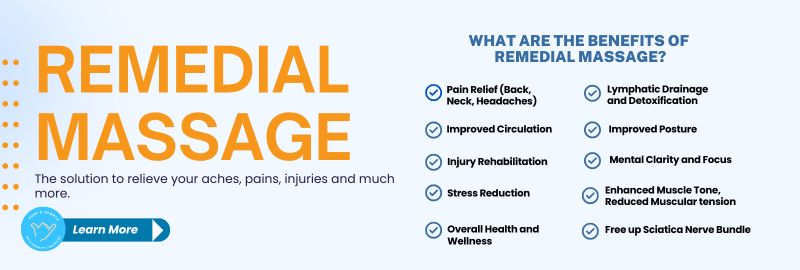
The benefits of remedial massage and the benefits of remedial therapy are usually about function and comfort:
- Help relieve muscle tightness and muscle tension
- Pain relief and reduced pain sensitivity
- Better range of motion and easier movement
- Support for better posture and posture improvement
Remedial massage can significantly improve day-to-day comfort for some people. It doesn’t guarantee you’ll be pain-free, and it won’t replace rehab exercise when that’s the main driver.
Some people choose to combine massage with physical therapy, or chiropractic care, depending on their needs and preferences.